


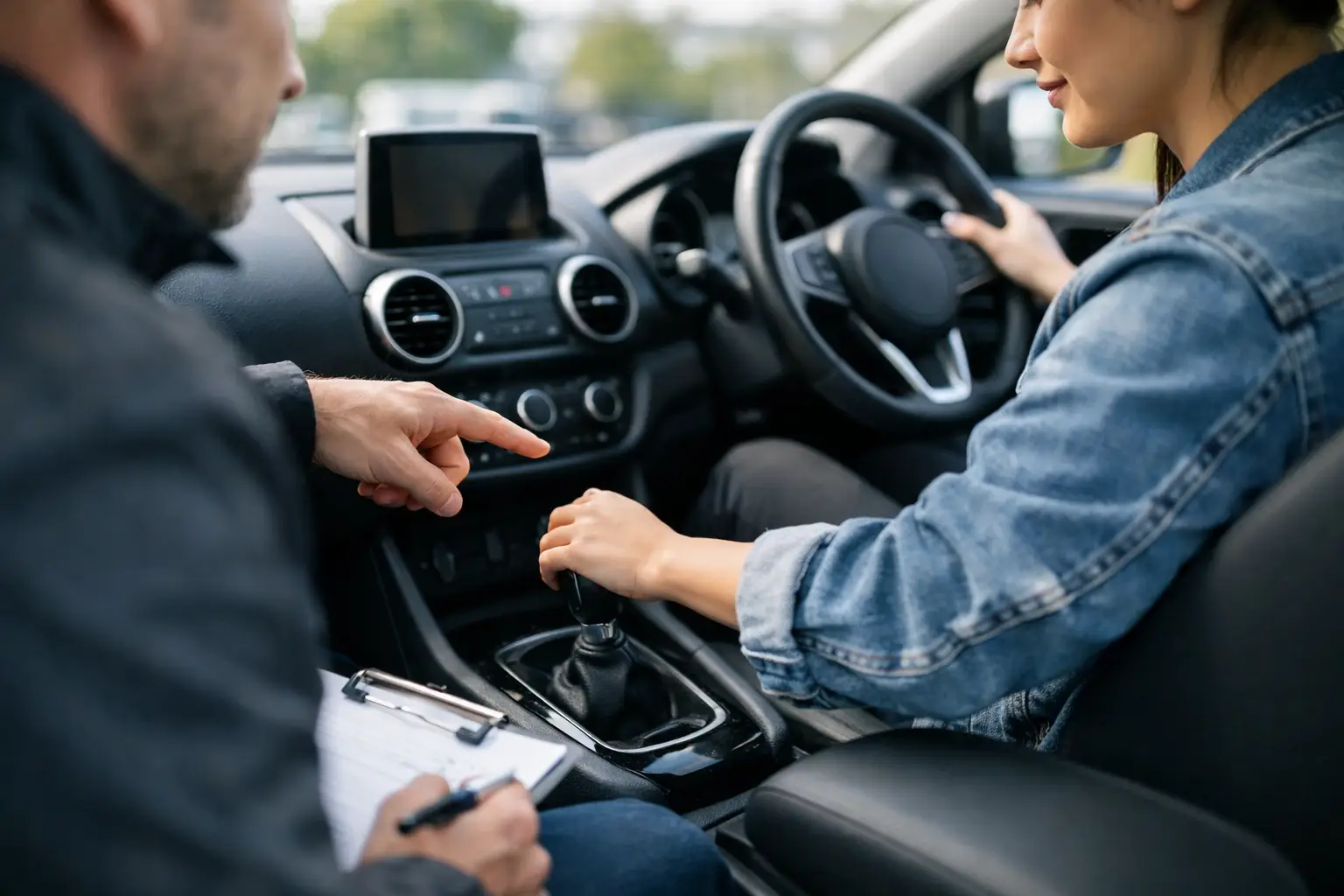
The first time you move off smoothly in a manual car can feel like a small miracle. One moment, the clutch, gears and pedals seem to need more coordination than you have available; the next, the car pulls away calmly and you realise it is a skill you can learn. This manual driving lessons guide explains what to expect, how lessons usually progress and how to build confidence without rushing yourself.
Learning in a manual gives you the option to drive both manual and automatic cars once you pass your test. It also teaches a close understanding of how the car responds to your inputs. That said, manual driving is not automatically the right choice for everyone. Your instructor should help you make a decision based on your confidence, needs and the type of driving you expect to do.
What happens in your first manual driving lesson?
A good first lesson is not about being thrown into busy traffic. Your instructor will begin by making sure you are comfortable in the driver’s seat, with the mirrors, steering wheel and head restraint correctly adjusted. You will be introduced to the main controls: clutch on the left, brake in the middle, accelerator on the right, gear lever, handbrake and the dashboard controls you need to use safely.
Before driving on the road, you will learn the basic routine for moving away and stopping. This normally takes place on a quiet, suitable road where there is time to think. Your instructor may use dual controls while you are getting used to the car, so you can focus on the process with reassurance nearby.
Expect your first few attempts to be imperfect. Stalling is common, especially when learning clutch control, and it does not mean you are failing. It simply tells you that the clutch came up too quickly, the accelerator needed a little more support, or both. A patient instructor will explain what happened and help you try again calmly.
Manual driving lessons guide: the skills you will build
Manual driving is learned in layers. You do not need to perfect every skill at once. As your control improves, your instructor will introduce more demanding roads, traffic conditions and independent decision-making.
Clutch control and moving away
The clutch is often the part learners worry about most. In simple terms, it allows you to change gear and control the connection between the engine and wheels. You will learn to find the biting point, where the car is ready to move, then combine a controlled lift of the clutch with gentle acceleration.
This takes practice because every car feels slightly different. The goal is not to hold the car at the biting point for long periods, particularly on hills, but to move away smoothly and efficiently. Over time, your feet will become more coordinated and the process will feel much less deliberate.
Changing gears at the right time
You will usually begin in first gear, then progress to second and higher gears as the road and speed allow. Your instructor will teach you how to listen to the engine, check the road ahead and select a suitable gear without staring at the gear lever.
Gear choice is about more than speed. A lower gear may give you better control when approaching a junction, travelling downhill or dealing with a tight bend. A higher gear is more suitable once the road is open and the vehicle is moving steadily. Good gear use supports safe, smooth and fuel-efficient driving.
Junctions, roundabouts and planning ahead
Once the basic controls are settling in, the focus shifts towards observation and planning. At junctions and roundabouts, you will practise checking mirrors, signalling when needed, choosing the correct lane, adjusting your speed and selecting an appropriate gear.
Learners sometimes concentrate so hard on the pedals that they forget to look far enough ahead. This is normal early on, but it is why structured tuition matters. Your instructor will help you develop a routine that keeps your attention on what is happening around you, not only on what your feet are doing.
Hill starts and slow-moving traffic
Hill starts are a useful skill, particularly around Bath and the surrounding area where gradients can be part of everyday driving. You will learn how to secure the car, prepare to move, find the biting point and release the handbrake without rolling backwards.
Slow traffic also requires calm clutch control. The answer is not to creep constantly on the biting point. Sometimes it is safer and easier to leave a little more space, move forward in a controlled way and stop again if necessary. Your instructor will show you how to keep the car under control while protecting the clutch from unnecessary wear.
How many manual lessons will you need?
There is no honest one-size-fits-all answer. Some people have plenty of previous experience with a family member, while others are starting from scratch. Confidence, frequency of lessons, time available for private practice and how quickly you absorb new routines all make a difference.
Regular lessons tend to help learners progress more steadily than long gaps between sessions. A two-hour lesson can be particularly useful because there is time to settle in, practise a skill properly and reflect on it before the lesson ends. Block bookings can also provide continuity, helping you and your instructor plan your progress rather than treating each lesson as a separate starting point.
Passing quickly should not be the only aim. Being ready for independent driving means you can deal with an unfamiliar route, busy traffic, poor weather or a mistake by another road user without losing your focus. That confidence is worth building properly.
Manual or automatic: which is right for you?
A manual licence allows you to drive manual and automatic vehicles. An automatic-only licence limits you to automatic cars, unless you later pass a manual test. For learners who want the broadest choice of vehicles, manual lessons can make practical sense.
However, automatic lessons may be a better fit if you feel overwhelmed by clutch and gear work, need to pass for work within a particular timeframe, or expect to drive an automatic vehicle long term. There is no prize for choosing the harder route. The best choice is the one that helps you become a safe, attentive and confident driver.
If you are unsure, speak openly with your instructor after a few lessons. They can assess how you are progressing and give straightforward advice without pressure.
Getting more from each driving lesson
You do not need to study for hours between lessons, but a little preparation can make a real difference. Review the key routine you covered, such as moving away, approaching a junction or parking. If you have access to suitable private practice with someone who meets the legal requirements, agree on one simple objective rather than trying to practise everything at once.
It also helps to arrive rested, wearing comfortable shoes with a thin enough sole to feel the pedals. Tell your instructor if you are nervous, tired or finding a particular skill difficult. Driving lessons are one-to-one for a reason: the pace and explanation can be adapted to you.
For the theory test, build your knowledge alongside practical lessons. Understanding road signs, stopping distances, vulnerable road users and the Highway Code makes real-road decisions easier. Theory and practical driving support each other.
Preparing for the practical test
A test-ready manual driver does not need to drive perfectly. They need to drive safely, legally and independently, showing consistent observations, appropriate speed and good control of the car. A stall on its own is not necessarily a disaster, but how you respond matters. Stay calm, secure the car if needed and move off safely when it is appropriate.
Your instructor will use mock tests and focused practice to identify any gaps before booking the practical test. This might include manoeuvres, meeting traffic on narrow roads, roundabouts, dual carriageways or following sat nav directions. Local knowledge of roads in Bath, Bristol, Keynsham and Kingswood can help make that preparation feel more familiar, but the underlying skills should work wherever you drive.
At SE7EN Driving School, the aim is to help learners become safe, confident drivers for life, not simply drivers who can repeat a route on test day. Take each lesson one skill at a time, ask questions whenever something feels unclear, and allow your confidence to grow through practice. The smooth pull-away will come, and so will the freedom that follows.