


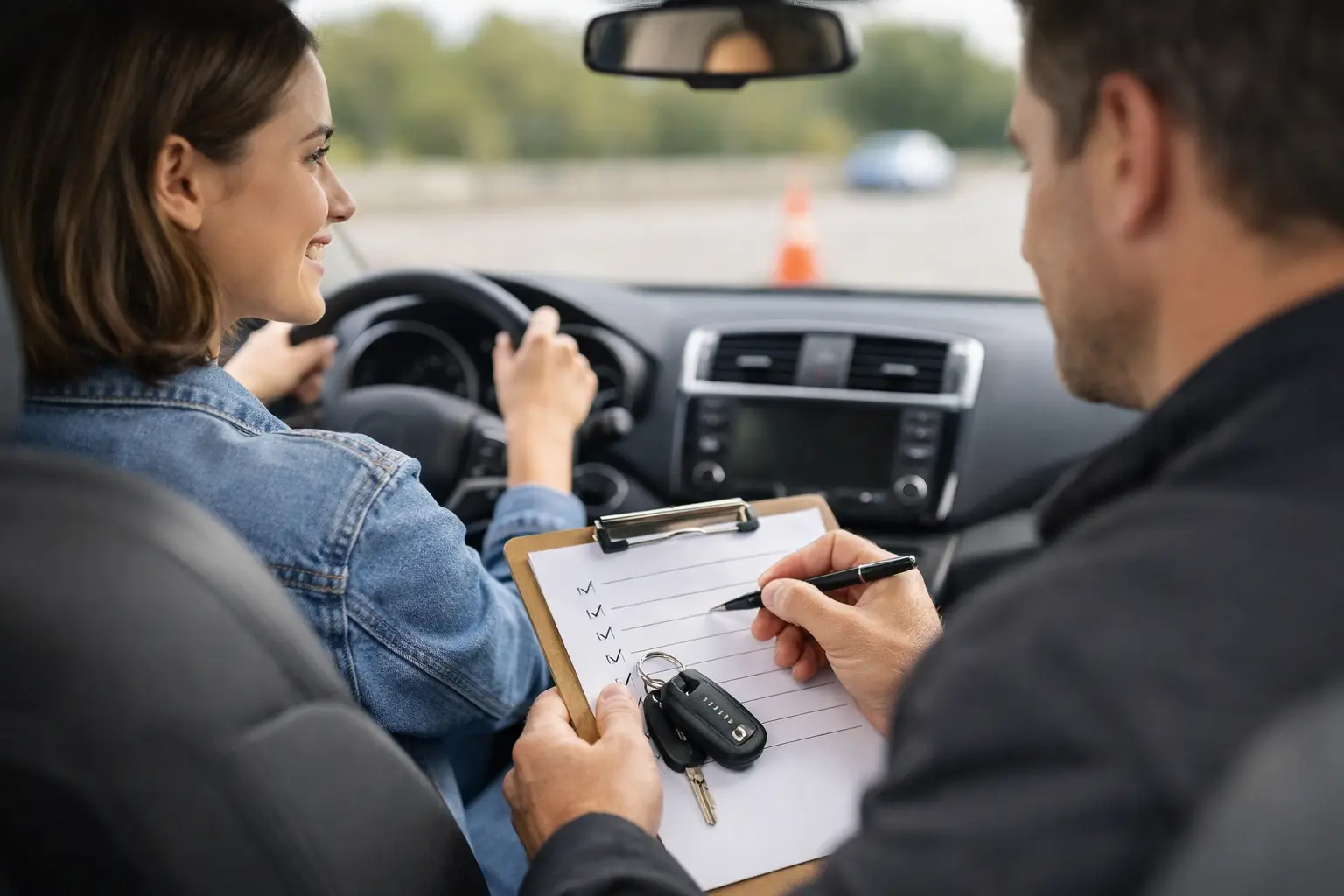
The night before your first lesson can make a short journey to the shops feel like a major event. That is completely normal. A good first driving lesson checklist takes the pressure off the practical details, so you can give your attention to the road, your instructor and the new skills you are about to learn.
Your first session is not an audition. You are not expected to know how to move off, change gear or park before you arrive. It is the starting point for learning safely, at a pace that works for you.
First driving lesson checklist: what to prepare
Bring your provisional driving licence. Your instructor will need to check that you are legally entitled to learn, so keep it somewhere safe and easy to find. If you have only recently applied for it, check that it has arrived before confirming your first lesson.
Wear comfortable clothing that lets you move freely. You do not need special driving clothes, but avoid anything restrictive or bulky that makes it harder to turn, reach the controls or check blind spots. If you are coming from college, work or another appointment, a quick change into something comfortable can help you feel more at ease.
Footwear matters more than many new learners expect. Choose flat, secure shoes with reasonably thin soles, so you can feel the pedals properly. Trainers are usually a sensible choice. Avoid high heels, heavy boots, flip-flops or loose sandals, as they can make pedal control less consistent.
Before you leave home, make sure you have:
- your provisional driving licence
- glasses or contact lenses if you need them for distance vision
- comfortable, secure footwear
- your mobile phone charged, with your instructor’s number saved
- water if it is a warm day or you are likely to feel nervous
- any booking details or pick-up information you have been given
You do not need to bring your own car, insurance documents or driving manual when learning with a professional instructor. The tuition vehicle is insured for lessons and fitted with dual controls, allowing your instructor to intervene if needed.
Check your eyesight and travel plan
You must be able to read a number plate from 20 metres for vehicles with a new-style number plate, or 20.5 metres for older-style plates. This is a legal eyesight requirement for driving. If you use glasses or contact lenses for distance, wear them for every lesson and keep a spare pair available where possible.
Plan how you will get to the pick-up point and allow a few extra minutes. Being late can make nerves worse and shorten your useful learning time. If your instructor is collecting you from home, be ready a little early and keep your mobile phone nearby in case traffic or roadworks affect the arrival time.
For learners in Bath, Bristol, Keynsham or Kingswood, the route and starting location may vary according to traffic, your experience and the skills planned for the lesson. Your instructor will choose an appropriate place to begin, often away from busy junctions and complicated roundabouts when you are new to driving.
Eat, rest and be honest about how you feel
A first lesson requires concentration. Try to get a decent night’s sleep, and eat something light beforehand rather than arriving hungry or overly full. Caffeine is fine if it is part of your usual routine, but several energy drinks can leave an already nervous learner feeling shaky.
If you are anxious, tell your instructor at the start. There is no prize for pretending you are relaxed. A patient instructor can explain each stage more slowly, give you more time to process instructions and choose quieter roads where appropriate. Nervousness is useful information, not a failure.
The same applies if you have any relevant health condition, injury or learning need that could affect your comfort or concentration. Sharing this early helps your lessons be adapted around you. Good driving instruction is one-to-one, not one-size-fits-all.
Know what your first lesson may involve
Many beginners expect to pull straight into traffic. Usually, the first part of a lesson is much calmer. Your instructor may drive to a quiet location before inviting you into the driver’s seat. They will talk you through the car’s basic controls and make sure you are positioned correctly before the engine is even started.
You are likely to cover the cockpit drill: adjusting the seat, mirrors and head restraint, checking that the doors are secure, and understanding the controls. You may also learn the basic routine for moving away and stopping safely. In a manual car, this can include clutch control and selecting first gear. In an automatic, you will focus more on brake control, gear selection and smooth observation.
Depending on how comfortable you feel, you may practise moving off and stopping several times on a quiet road. You might also begin simple steering and learn how to use the mirrors before changing direction. The exact plan depends on you. Some learners have previous experience in a family car, while others are sitting behind the wheel for the first time.
Do not measure your progress against a friend who says they drove around town on lesson one. A controlled start builds better habits than being rushed into situations you are not ready for.
Questions worth asking your instructor
Your instructor should explain what you are doing and why, but it helps to ask questions as they arise. You might ask how long lessons are, what is expected between sessions, or whether manual or automatic tuition best suits your goals. Neither choice is automatically right for everyone.
A manual licence lets you drive both manual and automatic cars, while an automatic licence limits you to automatic vehicles. Automatic lessons can feel simpler at the beginning because there is no clutch or gear changing to manage. Manual tuition may suit you if you want the broader licence category and are happy to spend time developing coordination. Your instructor can discuss the practical trade-off based on your confidence, budget and likely car choice after passing.
It is also useful to ask how progress will be tracked. Structured lessons should build from vehicle control and observations to junctions, roundabouts, independent driving and test preparation. Passing the practical test matters, but learning to make safe decisions when nobody is prompting you matters for much longer.
Set one realistic goal for the session
Your goal does not need to be impressive. It could be as simple as understanding where the pedals are, moving off once with control, or feeling comfortable in the driver’s seat. Small, clear aims are easier to achieve and give you something positive to reflect on afterwards.
Try not to tell yourself that you must be naturally good at driving. Driving is a learned skill, built through repetition, feedback and time. Stalling a manual car, braking too sharply or forgetting a mirror check are common early mistakes. They are opportunities to understand the process, not reasons to give up.
After the lesson: make progress easier
Give yourself a few minutes to think about what went well and what felt difficult. Write down one or two points while they are fresh, especially if your instructor gives you a simple practice task or explains a routine you want to remember. Avoid trying to memorise every word from the lesson. Focus on the key skill you will return to next time.
Regular lessons are usually more helpful than long gaps, because your confidence and coordination have less time to fade. If your schedule allows, booking a steady pattern can make learning feel more familiar and less overwhelming. SE7EN Driving School supports this structured approach with lessons designed around your pace, experience and local driving conditions.
Arrive prepared, ask for help when you need it, and allow yourself to be a beginner. Every safe, confident driver once had a first lesson too.