


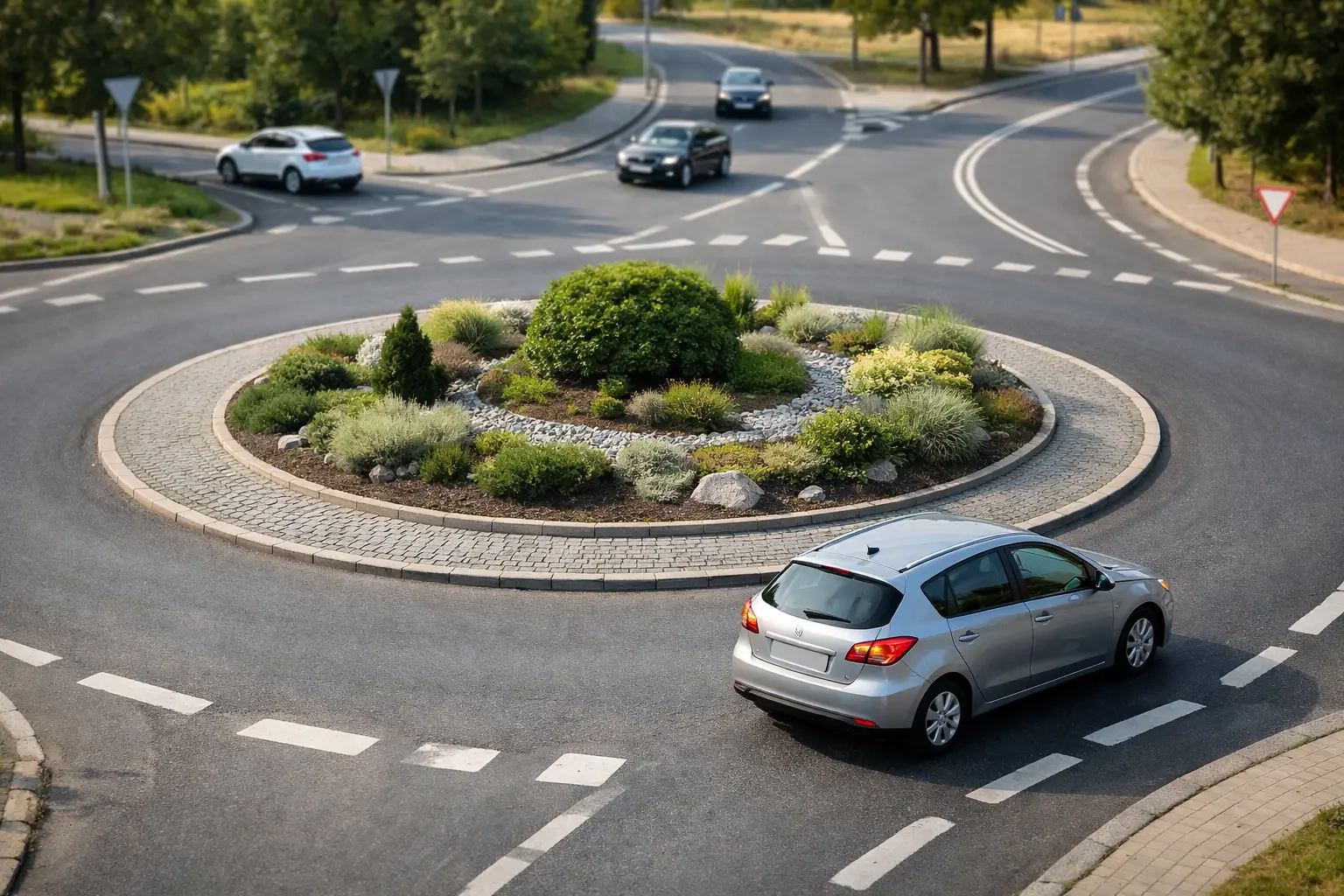
That moment when you spot a roundabout ahead can make even a good lesson feel more challenging. There are signs to read, lanes to choose and other road users to watch, all within a short distance. Learning how to master roundabouts safely is not about rushing or memorising one fixed routine. It is about developing a calm, repeatable process that helps you make safe decisions on every approach.
Roundabouts are a regular part of driving in Bath, Bristol, Keynsham and Kingswood. Some are small and quiet; others are busy, multi-lane junctions with pedestrians, cyclists and heavy traffic nearby. With patient practice, they become one of the most manageable parts of everyday driving.
Start with the roundabout routine
A safe roundabout begins before you reach the give way line. As soon as you see the advance warning sign, start planning. Check the road markings, look for direction signs and think about which exit you need. This gives you time to position the car correctly without sudden steering or last-minute lane changes.
A useful routine is mirrors, signal, position, speed and look. Check your mirrors early so you know what is happening behind and beside you. Signal if required for your intended direction, choose the appropriate lane, reduce speed progressively and then look properly at the traffic already on the roundabout.
Approach slowly enough that you can assess the situation. For many learners, second gear is suitable at a small roundabout, while a larger or busier one may require first gear or a complete stop. The correct gear depends on your speed, view and the traffic conditions. There is no prize for arriving quickly. Your priority is being able to give way and move off under control.
Know who has priority
At a standard UK roundabout, you give way to traffic approaching from your right that is already on the roundabout. This includes vehicles that may be moving quickly across your intended path. Look to the right, but do not stare there so long that you miss pedestrians, cyclists or traffic ahead.
Wait for a gap that is safe for your experience level and the power of the vehicle. A gap that an experienced driver can use may not feel comfortable for a new driver, especially in a manual car on an uphill approach. Taking an extra moment is usually safer than pulling out and causing another driver to brake or change direction.
Be particularly careful around motorcyclists and cyclists. They can be harder to spot and may be travelling faster or slower than you expect. Large vehicles also need extra space. A bus or lorry may use more than one lane, particularly on a smaller roundabout, so avoid driving alongside it where possible.
Choosing the correct lane at a roundabout
Lane choice is one of the main reasons roundabouts feel confusing. The signs and road markings always take priority, so read them early. On many roundabouts, the left lane is used for turning left or going ahead, while the right lane is used for turning right and often for later exits. However, this is not a rule to apply blindly.
Some larger roundabouts use different lane arrangements, including separate lanes for particular destinations. A painted arrow on the road or a lane sign may tell you to use a lane that feels different from the general rule. Follow the road layout, not assumptions.
If you are turning left, approach in the left lane where appropriate and signal left on approach. If you are taking an exit to the right, normally approach in the right lane and signal right. For an exit straight ahead, you will often approach without signalling, unless signs or markings say otherwise.
Once you are on the roundabout, stay in your lane. Avoid cutting across lanes to reach an exit. If you realise you are in the wrong lane, continue safely around the roundabout and take the route available to you. Missing an exit is inconvenient; making a sudden manoeuvre is dangerous.
When to signal on the way out
For most exits, signal left after you have passed the exit before the one you want. This gives other road users a clear indication that you are leaving. Check your left mirror before moving towards the exit, especially where a cycle lane, cyclist or motorcyclist could be present.
Do not signal so early that it suggests you are leaving at the previous exit. Equally, do not wait until you are already turning off. Timely signals are clear, helpful and predictable.
How to master roundabouts safely in busy traffic
Busy roundabouts can make learners feel pressured by vehicles waiting behind them. Remember that the driver behind cannot see exactly what you can see. They may be happy with a smaller gap, but you must make the decision that is safe for you.
Keep your attention forward and avoid being rushed. If you need to wait, hold the car securely with the footbrake or handbrake as appropriate. In a manual car, practising clutch control on different gradients can make moving away at a roundabout much less stressful. In an automatic, use the brake firmly and be ready to move only when you have identified a safe gap.
At multi-lane roundabouts, look beyond the vehicle immediately to your right when possible. Traffic in another lane may be crossing your path, and a vehicle may change lanes unexpectedly. This does not mean trying to predict everything. It means keeping your speed low enough and your observations wide enough to respond safely.
Traffic lights on a roundabout need the same careful attention. Obey the signal controlling your lane, even if another part of the roundabout appears clear. When the lights change, check that it is safe to proceed. Other drivers may still be clearing the junction.
Common mistakes and how to avoid them
Most roundabout errors happen because drivers feel they need to decide too late. Planning from the advance sign reduces the chance of incorrect lanes, rushed signals and harsh braking.
Another common mistake is looking only to the right at the give way line. You must give way to the right, but still check the crossing area ahead and remain aware of vulnerable road users. At mini-roundabouts, remember that you should drive around the central markings rather than straight over them, unless your vehicle makes that unavoidable.
Learners can also over-focus on getting the perfect gap. In real traffic, the aim is not perfection. It is a safe, sensible opportunity to join without affecting others. Your instructor can help you learn what a suitable gap looks like in different conditions, from quiet residential roads to busy commuter routes.
Finally, avoid treating every roundabout as identical. A small mini-roundabout near a housing area needs a different approach from a large, signposted junction on a main road. Weather, visibility, lane markings, traffic flow and the type of vehicle you are driving all matter.
Build confidence through focused practice
Confidence comes from repetition with a clear purpose. Start on quieter roundabouts where you have time to practise the full routine. Once that feels comfortable, move on to busier junctions, different lane layouts and routes you may use after passing your test.
It can help to talk through your plan aloud during lessons: which exit you need, which lane you will use, when you will signal and where you will look. This may feel unusual at first, but it turns a fast-moving situation into a sequence of manageable decisions.
A professional instructor can also spot patterns that are hard to notice yourself, such as approaching too quickly, waiting too long, missing lane signs or cancelling a signal too early. At SE7EN Driving School, roundabout practice is built around your current ability, so you can progress from quiet local junctions to more demanding routes at a pace that supports safe, confident driving.
The next time a roundabout appears ahead, give yourself space to plan, slow down and trust the routine. Each calm approach is another step towards driving independently with confidence.