


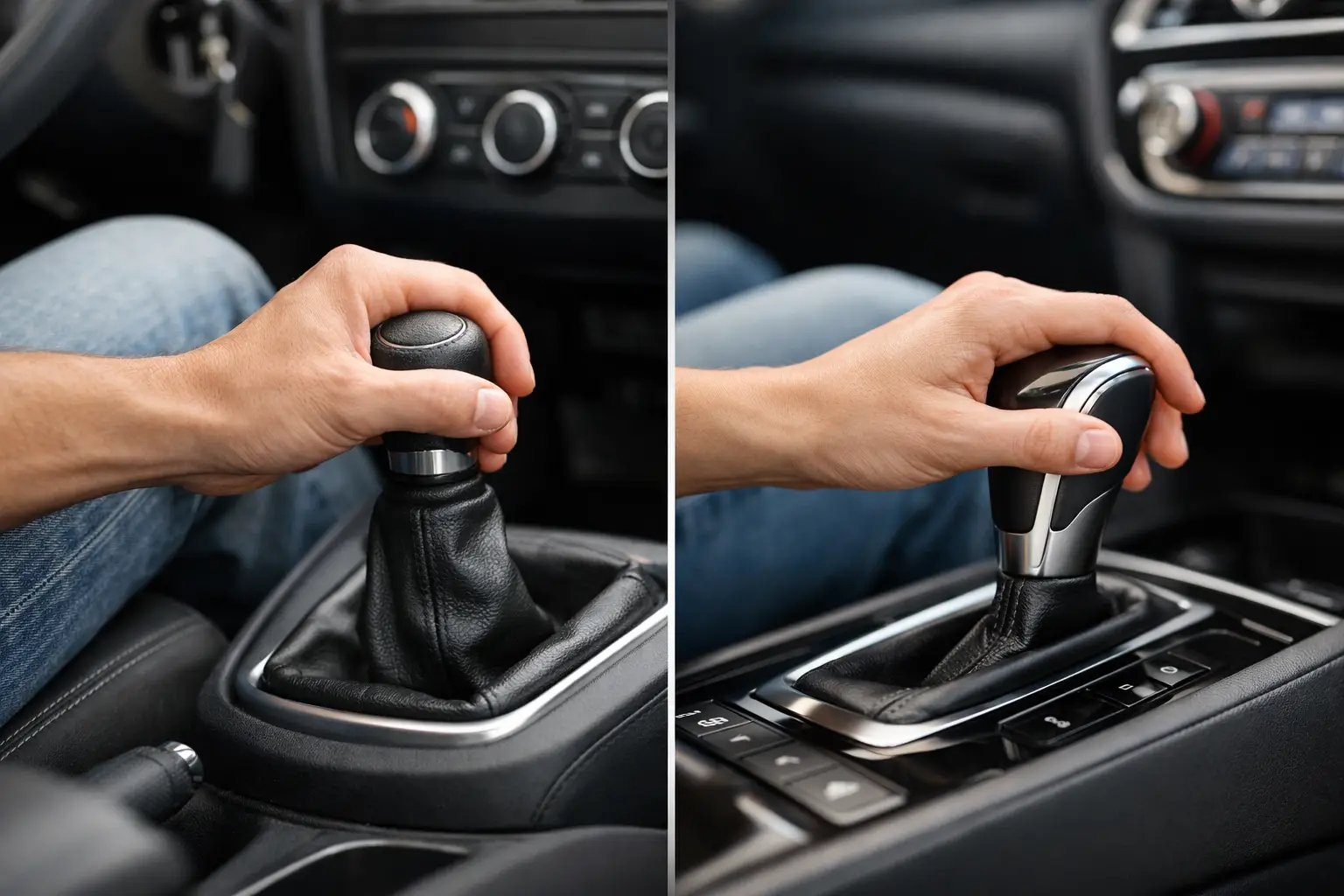
The first time you sit in the driver’s seat, there is already plenty to think about: mirrors, pedals, steering, road signs and other traffic. Choosing manual or automatic for beginners can feel like one more big decision. The right answer is not the same for everyone. It depends on how you want to learn, the car you expect to drive and what will help you become a safe, confident driver.
Manual or automatic for beginners: the key difference
A manual car has three pedals: accelerator, brake and clutch. You select the gears yourself using the gear lever. Early manual lessons include learning clutch control, finding the biting point, moving away smoothly and changing gear at the right time.
An automatic car has two pedals: accelerator and brake. The car changes gears for you, so there is no clutch pedal and no need to select gears during normal driving. This gives many learners more attention for steering, planning ahead and responding calmly to the road.
Neither option is “better” in every situation. Automatic lessons can feel simpler at the beginning, while manual lessons give you a wider licence entitlement if you pass your test in a manual car.
Your licence options matter
This is usually the most practical part of the decision. If you pass your practical driving test in a manual car, you can drive both manual and automatic cars. If you pass in an automatic car, your licence allows you to drive automatic vehicles only.
For some learners, having the freedom to drive either type of car is a strong reason to choose manual. It may make it easier to borrow a family car, use a work vehicle or find a wider choice of used cars later on.
However, an automatic-only licence is still a full driving licence. It is not a lesser pass, and it does not mean you are less capable on the road. You still need to demonstrate safe observation, good judgement, controlled manoeuvres and independent driving. If an automatic is the car you are likely to own or use, an automatic licence may be the most sensible fit for your life.
Why some beginners prefer automatic lessons
Automatic driving lessons can reduce the number of tasks you manage at once. When pulling away at a busy junction, for example, you do not need to balance the clutch and accelerator or worry about selecting first gear. You can focus on checking it is safe, moving off smoothly and positioning the car well.
This can be particularly helpful for nervous learners, people learning around a busy job or university timetable, and anyone who has found manual driving frustrating in the past. Fewer mechanical tasks can make progress feel more immediate, which often supports confidence.
Automatic cars can also be more comfortable in stop-start traffic. Around Bath, Bristol, Keynsham and Kingswood, traffic lights, hill starts and congested routes are a normal part of driving. Without a clutch, queues and repeated hill starts may feel less demanding.
There is another long-term consideration. Many hybrid and electric cars are automatic, and the number of automatic vehicles on UK roads continues to grow. For learners who expect to drive an electric or hybrid car, automatic tuition prepares them directly for the type of vehicle they are likely to use.
Automatic is not always the quickest route
It is tempting to assume automatic lessons always mean fewer lessons. Some learners do progress faster because they have less to coordinate, but everyone learns at a different pace. You will still need time to develop observation, anticipation, road awareness and decision-making.
Your progress depends on lesson consistency, private practice where appropriate, your previous experience and how comfortable you feel. A calm, structured approach is more useful than rushing to book a test before your driving is ready.
Why manual lessons remain a strong choice
Learning manual gives you greater flexibility after passing your test. If you are unsure which car you will drive in the future, or your household has a manual car available for practice, it can be a practical choice.
Manual driving also helps you understand how the car responds to different gears and road conditions. Once clutch control becomes natural, many learners enjoy the sense of control and find gear changes become part of their normal routine.
For driving in hilly areas, manual learners will need to practise hill starts thoroughly. This can feel challenging at first, especially when another vehicle is waiting behind you. With patient instruction and repetition, though, it becomes a manageable skill rather than something to fear.
Expect a slower start, not a harder future
The first few manual lessons can feel busy. Stalling is common, and it is not a sign that you cannot learn to drive. It is simply part of understanding the clutch and timing your movements.
A good instructor will break the skill into small stages: setting off, stopping, clutch control on a quiet road, then moving on to junctions and busier conditions when you are ready. The aim is not perfection in the first hour. It is steady progress that builds safe habits for life.
Think about your real driving life
Before deciding, consider the car you will most realistically drive after passing. If your parents, partner or housemates have a manual car and you hope to use it regularly, manual instruction could offer better value. If you are saving for an automatic, expect to drive an electric car or want the simplest route into driving, automatic may suit you better.
Cost is worth considering too, but it should not be the only factor. Automatic cars can sometimes cost more to buy or insure, although this varies by model, driver profile and local availability. Manual cars may offer more second-hand choice. On the other hand, if automatic lessons help you learn comfortably and consistently, the extra choice of manual vehicles may not matter as much.
It also helps to be honest about what makes you anxious. Some people are worried about the clutch because friends have told them it is difficult. Usually, that fear fades with the right support. Others genuinely find that removing gear changes helps them stay calm and concentrate. Both reactions are valid.
Can you change from manual to automatic?
Yes. You are not locked into your first choice. A learner can move from manual lessons to automatic lessons if manual driving is taking attention away from essential road skills or affecting confidence. You can also start in an automatic and later take a further practical test in a manual car if you want to remove the automatic restriction from your licence.
Changing course can involve extra lesson time while you adjust, so it is useful to make an informed choice early. Still, there is no benefit in continuing with a car type that leaves you overwhelmed and reluctant to practise. Learning works best when you feel challenged but supported.
How to make the right choice with confidence
Start with your likely car, your budget and the type of driving you expect to do. Then think about how you learn. Do you enjoy taking on a technical skill gradually, or would you rather keep the mechanics simple while you build confidence on the road?
A conversation with a qualified instructor can also help. They can explain what your early lessons will look like, answer questions about local routes and help you choose tuition that matches your goals. At SE7EN Driving School, the focus is on helping each learner build safe, confident driving skills, whether that begins in a manual or automatic car.
The best choice is the one that gives you the confidence to keep learning, practise regularly and make thoughtful decisions every time you get behind the wheel.